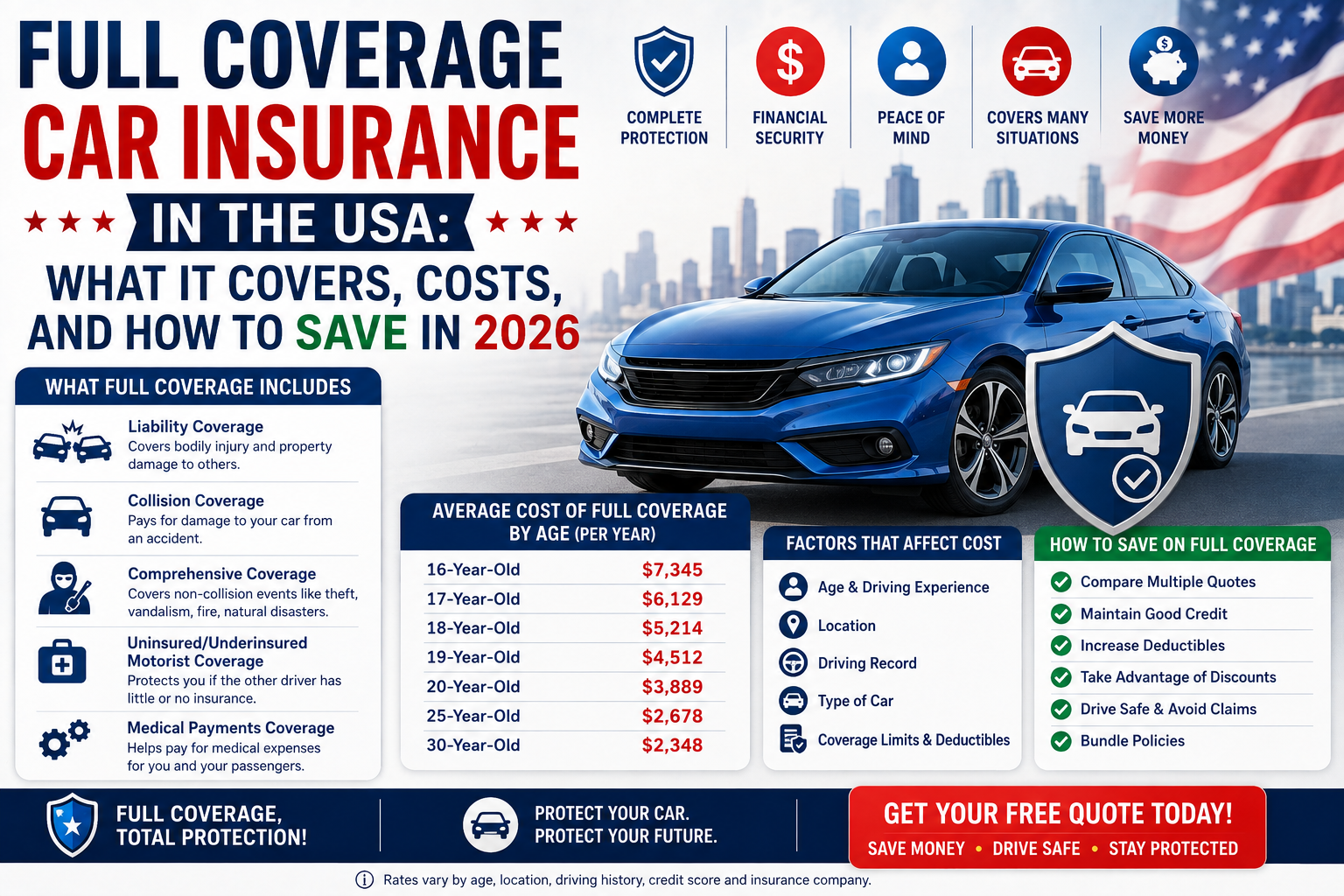
Full coverage car insurance is a popular choice for drivers who want more protection than the minimum liability insurance required by their state. Although the term “full coverage” is commonly used by consumers, it does not describe one specific insurance policy. Instead, it usually refers to a combination of liability coverage plus collision and comprehensive coverage.
The right amount of coverage depends on your vehicle, finances, state requirements, lender requirements, driving history, and personal risk tolerance. A policy with more coverage generally costs more, but it can provide valuable financial protection after certain accidents, theft, vandalism, storms, or other covered events.
This guide explains what full coverage car insurance means, what it typically includes, how much it may cost, when it makes sense, and how drivers can compare quotes in 2026.
What Is Full Coverage Car Insurance?
“Full coverage” is an informal term rather than a standardized insurance product.
When people talk about full coverage car insurance, they typically mean a policy that includes:
- Bodily injury liability coverage
- Property damage liability coverage
- Collision coverage
- Comprehensive coverage
Depending on your state and insurer, a full-coverage policy may also include or allow you to add:
- Uninsured motorist coverage
- Underinsured motorist coverage
- Medical payments coverage
- Personal injury protection
- Rental reimbursement
- Roadside assistance
- Gap coverage
- Custom equipment coverage
The exact combination varies by state and insurance company.
What Does Full Coverage Car Insurance Cover?
Full coverage can provide protection in several different situations.
Liability Coverage
Liability insurance generally helps pay for certain injuries or property damage you cause to another person when you are legally responsible for an accident, subject to the policy’s limits and conditions.
Liability coverage typically includes:
Bodily injury liability: May help cover eligible medical expenses and other covered damages for people injured in an accident you caused.
Property damage liability: May help pay for damage you cause to another person’s vehicle or property.
Every state has its own minimum insurance requirements, so the required limits vary.
Collision Coverage
Collision coverage generally helps pay to repair or replace your vehicle after a covered collision, subject to your deductible and policy terms.
Examples can include collisions with:
- Another vehicle
- A stationary object
- A fence
- A building
- Certain other objects
Collision coverage generally applies to damage to your own vehicle rather than injuries or property damage suffered by another party.
Comprehensive Coverage
Comprehensive coverage generally protects your vehicle against certain covered losses that are not caused by a collision.
Depending on the policy, covered events may include:
- Theft
- Vandalism
- Fire
- Falling objects
- Hail
- Windstorm
- Flood
- Certain animal-related damage
Comprehensive coverage is subject to the policy deductible and exclusions.
What Full Coverage Does Not Cover
Despite its name, full coverage does not mean your vehicle and every possible expense are automatically covered.
For example, standard full coverage generally does not mean unlimited protection for:
- Mechanical breakdowns
- Normal wear and tear
- Maintenance
- Every type of personal injury
- Every item inside your vehicle
- Intentional damage
- Every rental-car expense
- Every type of aftermarket modification
Coverage depends on the policy language, exclusions, limits, and applicable state law.
That is why it is important to read the policy rather than assuming “full coverage” means everything is covered.
Is Full Coverage Car Insurance Required?
In most situations, state law requires liability insurance, but collision and comprehensive coverage are generally not required by state law.
However, if you finance or lease your vehicle, your lender or leasing company may require collision and comprehensive coverage as part of the financing or lease agreement.
If you own your car outright, you generally have more flexibility regarding optional physical-damage coverage, subject to state requirements for other types of coverage.
Before dropping collision or comprehensive insurance, check your loan or lease agreement.
How Much Does Full Coverage Car Insurance Cost?
There is no single nationwide price for full coverage.
Your premium can depend on:
- Age
- State
- ZIP code
- Driving history
- Vehicle make and model
- Vehicle value
- Annual mileage
- Credit-based insurance information where permitted
- Claims history
- Coverage limits
- Deductible
- Insurance history
- Discounts
Two drivers with the same vehicle can receive very different quotes.
Similarly, the same driver may receive substantially different prices from different insurance companies.
For that reason, national average rates should be used only as a general reference. A personalized quote is much more useful.
Full Coverage vs. Liability-Only Insurance
One of the most important decisions for drivers is whether to purchase liability-only insurance or broader coverage.
| Feature | Liability Only | Full Coverage |
|---|---|---|
| Damage you cause to others | Usually covered | Usually covered |
| Injuries you cause to others | Usually covered | Usually covered |
| Damage to your own vehicle after covered collision | Usually not covered | Generally covered |
| Theft | Generally not covered | Generally covered through comprehensive |
| Vandalism | Generally not covered | Generally covered through comprehensive |
| Weather-related damage | Generally not covered | Generally covered through comprehensive |
| Monthly premium | Usually lower | Usually higher |
| Deductible for own vehicle | Usually none for vehicle damage | Usually applies |
Actual coverage depends on the policy and state.
Is Full Coverage Worth It?
For many drivers, full coverage can be worthwhile, particularly when the vehicle has substantial value.
Consider full coverage if:
- Your vehicle is relatively new
- You have a financed car
- You lease your vehicle
- You could not comfortably replace your vehicle after a major loss
- You frequently drive in areas with severe weather
- Your vehicle has a higher theft risk
- You want additional protection against damage to your own vehicle
On the other hand, drivers with older vehicles worth relatively little may decide that paying for collision and comprehensive coverage is no longer financially attractive.
There is no universal answer.
When Should You Drop Full Coverage?
Some drivers eventually consider removing collision or comprehensive coverage from an older vehicle.
Before making that decision, compare:
Annual cost of collision and comprehensive coverage
against
The amount you could realistically recover if the vehicle were totaled
Remember that insurers generally pay the vehicle’s covered actual cash value rather than automatically paying the amount you originally paid for it.
If you could comfortably replace the vehicle yourself and the annual cost of physical-damage coverage is significant compared with the vehicle’s value, dropping certain coverage may be worth considering.
However, this should be evaluated carefully.
Full Coverage for a Financed Car
If you have an auto loan, your lender may require comprehensive and collision coverage.
The reason is straightforward: the vehicle serves as collateral for the loan.
If the vehicle is seriously damaged or stolen, the lender wants to ensure that the asset is protected.
Your lender may specify minimum:
- Liability limits
- Comprehensive deductible
- Collision deductible
Check your loan documents for the exact requirements.
Full Coverage for a Leased Car
Leasing companies typically require drivers to maintain specific insurance coverage.
The requirements can include higher liability limits and physical-damage coverage.
Before purchasing insurance for a leased vehicle, check the leasing company’s insurance requirements.
Failing to maintain required coverage could violate your lease agreement.
How Deductibles Affect Full Coverage Insurance
Your deductible is generally the amount you pay toward a covered loss before the insurance company pays the remaining covered amount.
For example, suppose your collision deductible is $1,000 and you have $5,000 of covered vehicle damage.
Subject to the policy terms, you would generally pay the first $1,000 and the insurer would pay the remaining $4,000.
Choosing a higher deductible can sometimes lower your premium.
However, you should only select a deductible that you could comfortably afford after an accident.
How to Find Cheap Full Coverage Car Insurance
Full coverage does not have to mean paying the highest possible premium.
Compare Multiple Insurers
Request quotes from several insurance companies.
Pricing can vary significantly between insurers for the same driver.
Compare Identical Coverage
When comparing quotes, use the same:
- Liability limits
- Collision deductible
- Comprehensive deductible
- Optional coverage
- Vehicle information
Otherwise, you may accidentally compare different levels of protection.
Ask About Discounts
Depending on the insurer and state, discounts may be available for:
- Safe driving
- Multiple vehicles
- Bundling
- Good students
- Driver education
- Low mileage
- Telematics programs
- Vehicle safety features
Ask the insurer which discounts you qualify for.
Maintain a Clean Driving Record
Accidents and traffic violations can increase insurance costs.
Following traffic laws and maintaining safe driving habits can help you develop a stronger insurance history over time.
Consider Your Deductible
If financially appropriate, compare different deductible levels to see how they affect your premium.
Don’t choose a high deductible simply because the monthly premium looks cheaper.
Full Coverage Car Insurance for Young Drivers
Young drivers often pay more for auto insurance because of limited driving experience.
Full coverage can be particularly expensive for young drivers because the policy includes protection for their own vehicle in addition to liability coverage.
Young drivers can potentially save by:
- Staying on a family policy when appropriate
- Comparing multiple insurers
- Maintaining good grades
- Completing qualifying driver education
- Using eligible telematics programs
- Choosing a practical vehicle
- Maintaining a clean driving record
Before buying a vehicle, request an insurance quote. A vehicle that looks affordable to purchase may be expensive to insure.
Full Coverage Car Insurance After an Accident
An accident can affect your insurance premium depending on the circumstances.
If you have an accident and your current insurer raises your premium, you can compare quotes from other companies when you are eligible to switch.
However, always provide accurate information about accidents and claims.
You should also check whether your policy includes an accident-forgiveness feature and whether you meet its eligibility requirements.
Full Coverage for Drivers With Bad Credit
In some states, insurers may use credit-based insurance information when permitted by law.
If you have poor credit, your insurance premium may be affected depending on your state and insurer.
Drivers with bad credit can still:
- Compare several insurers
- Ask about discounts
- Maintain a clean driving record
- Review their credit reports for errors
- Compare different deductibles
- Evaluate coverage carefully
Some states restrict or prohibit insurers from using credit-based insurance scores for certain insurance decisions, so state-specific rules matter.
Does the Car You Drive Affect Full Coverage Rates?
Yes.
Vehicle characteristics can significantly affect premiums.
Insurers may consider:
- Vehicle value
- Repair costs
- Theft rates
- Safety features
- Claims history for the model
- Replacement-part costs
- Performance
A luxury vehicle may cost more to insure than a less expensive vehicle because repairs or replacement can be more expensive.
Similarly, a sports car may have different insurance pricing from a family sedan.
Full Coverage and Gap Insurance
Gap insurance is separate from traditional full coverage.
If your vehicle is totaled or stolen while you owe more on your auto loan than the vehicle’s covered value, gap coverage may help cover the difference, subject to its terms.
For example, imagine:
- Remaining loan balance: $25,000
- Insurance vehicle value: $21,000
- Difference: $4,000
Standard physical-damage coverage generally would not automatically pay the $4,000 loan balance difference.
Gap coverage may help with some or all of that difference depending on the policy.
Drivers with financed or leased vehicles should understand whether gap protection is included or available separately.
Full Coverage and Uninsured Drivers
Uninsured and underinsured motorist coverage can be important because not every driver carries adequate liability insurance.
These coverages can help protect you in certain situations involving another driver who does not have enough insurance, subject to state law and policy terms.
Whether this coverage is required or optional depends on your state.
When comparing full-coverage policies, check whether uninsured and underinsured motorist coverage is included.
Full Coverage for Older Cars
An older car does not automatically mean you should drop full coverage.
Consider:
- Current vehicle value
- Annual insurance cost
- Deductible
- Repair costs
- Your ability to replace the vehicle
- Your risk tolerance
For example, if your vehicle is worth $6,000 and your collision and comprehensive coverage costs $900 annually with a $1,000 deductible, you may want to evaluate whether the protection is worth the cost.
There is no universal cutoff.
Full Coverage Car Insurance by State
Insurance requirements vary by state.
States determine their own minimum requirements for liability and other types of coverage.
Your premium can also vary significantly depending on where you live.
Factors can include:
- Traffic density
- Accident frequency
- Theft
- Weather
- Repair costs
- Litigation
- State insurance regulations
Therefore, the best full-coverage policy for a driver in Texas may not be the best option for someone in California, Florida, New York, Ohio, or another state.
How to Compare Full Coverage Quotes
Use this simple process:
Step 1: Determine Your Coverage Needs
Decide what liability limits and optional coverage you want.
Step 2: Collect Vehicle Information
Have your VIN, mileage, ownership details, and vehicle information available.
Step 3: Request Several Quotes
Compare prices from multiple insurers.
Step 4: Use the Same Coverage
Make sure the quotes are based on comparable limits and deductibles.
Step 5: Compare Discounts
Ask about all available discounts.
Step 6: Review the Policy
Check:
- Coverage limits
- Deductibles
- Exclusions
- Optional coverage
- Claims procedures
- Renewal terms
Step 7: Check Your Lender Requirements
If your vehicle is financed or leased, make sure the policy meets the lender’s requirements.
Common Full Coverage Insurance Mistakes
Mistake 1: Assuming “Full Coverage” Covers Everything
It does not. Always read the policy.
Mistake 2: Choosing Only by Monthly Price
The cheapest policy may have lower limits or higher deductibles.
Mistake 3: Ignoring the Deductible
A low premium with a very high deductible may not be suitable for your budget.
Mistake 4: Not Comparing Quotes
Different insurers can offer very different prices.
Mistake 5: Dropping Coverage Without Checking a Loan
Your lender may require comprehensive and collision coverage.
Mistake 6: Giving Incorrect Information
Always provide accurate information when requesting insurance quotes.
Frequently Asked Questions
What is full coverage car insurance?
Full coverage generally refers to liability insurance combined with collision and comprehensive coverage. It is not a standardized insurance policy.
Is full coverage insurance required by law?
State laws generally require liability insurance, while collision and comprehensive coverage are typically optional under state law. A lender or leasing company may require them.
Is full coverage worth it on an old car?
It depends on the vehicle’s value, premium, deductible, and your ability to replace the car after a covered loss.
Does full coverage cover theft?
Comprehensive coverage generally covers theft of the insured vehicle, subject to the policy terms and deductible.
Does full coverage cover engine failure?
Generally, standard auto insurance does not cover ordinary mechanical breakdowns or maintenance-related failures.
Does full coverage cover another driver’s car?
Your liability coverage may help pay for certain damage you cause to another person’s vehicle when you are legally responsible, subject to your policy limits and conditions.
Can I get full coverage with bad credit?
Yes, depending on the insurer and state. Where permitted, credit-based insurance information may affect pricing.
Is full coverage more expensive for young drivers?
Young drivers often pay higher premiums because of their limited driving experience, and adding collision and comprehensive coverage can increase the cost further.
How can I make full coverage cheaper?
Compare multiple insurers, ask about discounts, maintain a clean driving record, choose an appropriate deductible, and review your coverage regularly.
Final Thoughts
Full coverage car insurance can provide significantly broader protection than minimum liability insurance, particularly for drivers who want coverage for damage to their own vehicle.
Although “full coverage” is not a standardized insurance product, it commonly combines liability, collision, and comprehensive coverage. Additional protections such as uninsured motorist coverage, rental reimbursement, roadside assistance, and gap insurance may also be available depending on your insurer and state.
The best policy is not necessarily the cheapest one. When comparing full coverage car insurance quotes, look at the complete package: premium, liability limits, deductibles, exclusions, optional coverage, discounts, and claims service.
If you finance or lease your vehicle, check your lender’s requirements before changing coverage. If you own an older vehicle outright, compare the cost of physical-damage coverage with the vehicle’s current value and your ability to replace it.
Most importantly, compare personalized quotes from several insurers. Rates can vary substantially from one company to another, so shopping around may help you find a better balance between price and protection in 2026.
Disclaimer
This article is for general informational purposes only and does not constitute insurance, legal, or financial advice. Auto insurance requirements, rates, coverage options, eligibility, discounts, deductibles, and underwriting practices vary by state, insurer, driver, and vehicle. “Full coverage” is not a standardized insurance policy. Always review the actual policy documents and verify current requirements with your insurer, state insurance department, lender, or a licensed insurance professional before making an insurance decision.