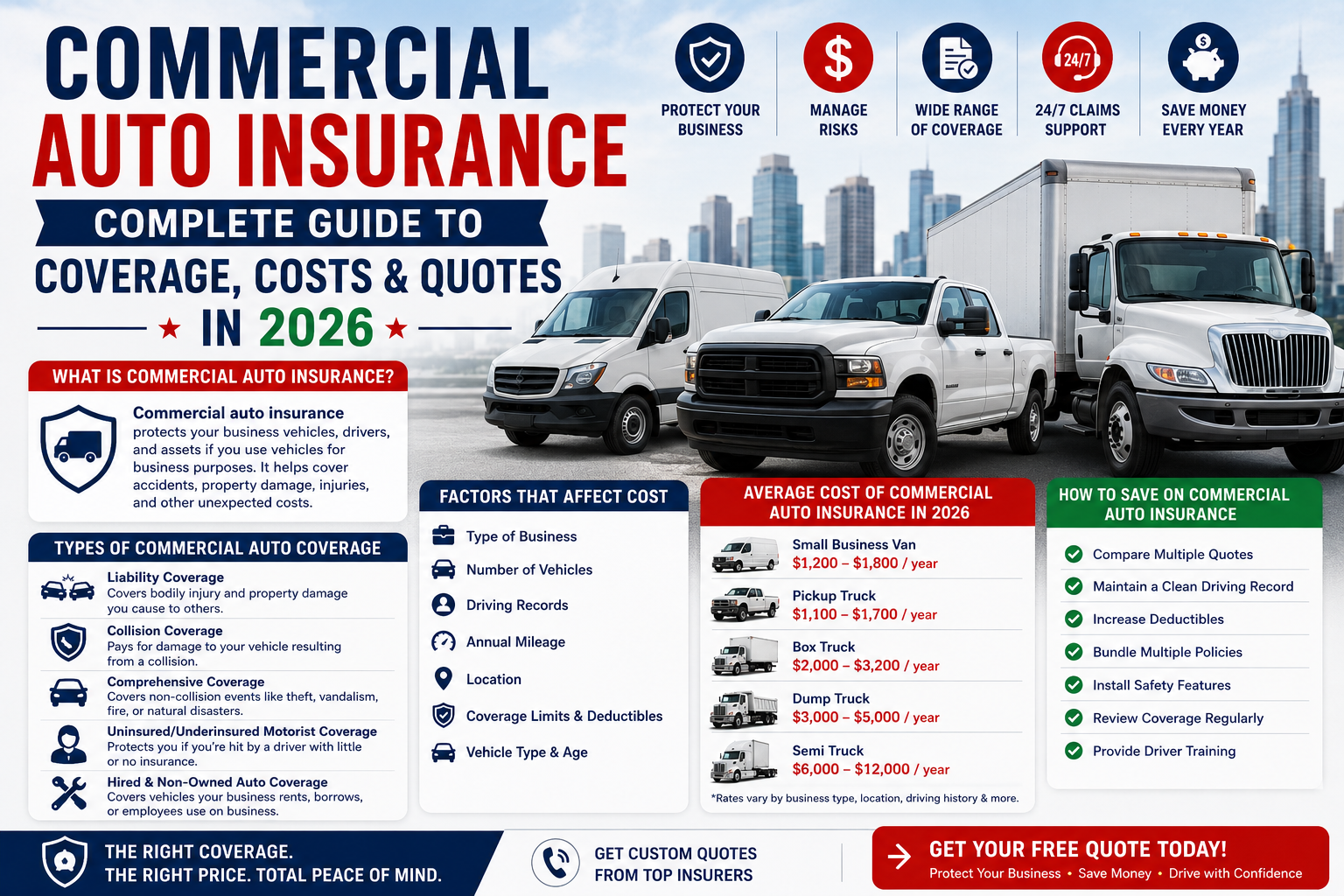
If you use vehicles for business purposes, commercial auto insurance can be an important part of protecting your company, employees, vehicles, and financial assets. A personal auto insurance policy may not provide the coverage you need when a vehicle is regularly used for business activities.
Commercial auto insurance is designed for vehicles used in connection with a business. Depending on the policy, it can provide liability protection as well as coverage for physical damage to business vehicles. Additional options may be available depending on the type of business, vehicle, drivers, and state requirements.
Whether you operate a delivery company, construction business, landscaping company, trucking operation, contractor business, or another company that relies on vehicles, understanding commercial auto insurance can help you make a more informed decision.
Important: Commercial auto insurance requirements and coverage options vary by state, insurer, vehicle type, and business activity. Always verify your specific requirements with a licensed insurance professional or your state’s insurance regulator.
What Is Commercial Auto Insurance?
Commercial auto insurance is insurance designed to cover vehicles that are owned, leased, hired, or otherwise used by a business.
It can be appropriate for vehicles such as:
- Business-owned cars
- Pickup trucks
- Cargo vans
- Delivery vehicles
- Box trucks
- Service vehicles
- Construction vehicles
- Food trucks
- Company SUVs
- Certain specialty vehicles
The policy can help protect your business against financial losses resulting from covered accidents and other covered events.
Commercial auto insurance is different from personal auto insurance because business vehicles and business activities can involve different risks.
Who Needs Commercial Auto Insurance?
A business may need commercial auto insurance when a vehicle is primarily used for business activities.
Examples include:
Contractors
Electricians, plumbers, HVAC technicians, roofers, painters, and other contractors may use trucks or vans to transport tools, equipment, and employees.
Delivery Businesses
Businesses that deliver food, packages, products, or other goods may require commercial coverage depending on how vehicles are used.
Landscaping Companies
Landscaping businesses often use pickup trucks, trailers, and service vehicles to transport equipment.
Construction Companies
Construction businesses may have multiple trucks, vans, and other vehicles operating at different job sites.
Real Estate Businesses
A vehicle used regularly for business activities such as transporting clients or traveling between properties may have different insurance considerations from ordinary personal use.
Cleaning Companies
Cleaning businesses may use vehicles to transport employees, supplies, and equipment.
Sales Businesses
Companies that require employees to regularly travel to customers or business locations may need appropriate commercial coverage.
The exact insurance requirement depends on the vehicle, business activity, ownership, and state.
Commercial Auto Insurance vs. Personal Auto Insurance
One of the most important differences is how the vehicle is used.
Personal auto insurance is generally intended for personal transportation and eligible personal activities.
Commercial auto insurance is designed for vehicles used in connection with business operations.
For example, consider a plumber who owns a pickup truck and uses it every day to travel to customer locations while carrying tools and equipment.
A personal policy may not provide the same protection as a properly structured commercial policy.
The key issue is not simply who owns the vehicle. How the vehicle is used matters.
What Does Commercial Auto Insurance Cover?
Commercial auto insurance policies can include several types of coverage.
1. Commercial Auto Liability Insurance
Liability coverage is one of the most important components of a commercial auto policy.
If an insured business driver causes an accident, liability coverage may help pay for certain:
- Bodily injuries
- Property damage
- Legal expenses
- Settlement costs
Coverage is subject to policy limits, exclusions, and applicable law.
Businesses should carefully consider liability limits because an accident involving a company vehicle could create significant financial exposure.
2. Collision Coverage
Collision coverage generally helps pay for covered damage to a business vehicle resulting from a collision.
Examples may include collisions with:
- Another vehicle
- A building
- A pole
- A fence
- Another stationary object
A deductible generally applies.
3. Comprehensive Coverage
Comprehensive coverage generally protects against certain covered losses that are not caused by a collision.
Depending on the policy, this may include:
- Theft
- Fire
- Vandalism
- Hail
- Wind
- Falling objects
- Certain animal-related damage
Coverage is subject to the policy’s terms and deductible.
4. Uninsured Motorist Coverage
Uninsured motorist coverage may protect the insured in certain situations involving a driver who does not have insurance.
Depending on the state and policy, underinsured motorist coverage may also be available.
Requirements vary by state.
5. Medical Payments Coverage
Some commercial auto policies may offer medical payments coverage.
It can help pay certain medical expenses resulting from an accident, depending on the policy and state requirements.
6. Hired and Non-Owned Auto Coverage
This can be particularly important for businesses that use vehicles they do not own.
Hired auto coverage may apply to certain vehicles rented or leased by the business.
Non-owned auto coverage may apply to certain situations involving vehicles owned by employees or other parties but used for business purposes.
The exact protection depends on the policy.
What Is Hired and Non-Owned Auto Insurance?
Hired and non-owned auto coverage is often relevant to businesses without a large company-owned fleet.
Hired Autos
A hired vehicle could include a vehicle rented by the business for business purposes.
Non-Owned Autos
A non-owned vehicle could include an employee’s personal vehicle used for certain business activities.
For example, an employee might use their personal vehicle to visit a customer or pick up business supplies.
A business should not assume that an employee’s personal auto insurance will fully protect the company.
Commercial insurance should be structured according to the actual business exposure.
How Much Does Commercial Auto Insurance Cost?
There is no standard commercial auto insurance price.
Premiums can vary significantly depending on factors such as:
- Business type
- Location
- Number of vehicles
- Vehicle type
- Vehicle value
- Vehicle usage
- Driving radius
- Employee driving records
- Claims history
- Coverage limits
- Deductibles
- Cargo or equipment being transported
- Years in business
- Industry risk
- State regulations
A small contractor with one pickup truck may receive a very different quote from a delivery company operating 20 vans.
For this reason, online averages should not be treated as personalized insurance quotes.
What Affects Commercial Auto Insurance Rates?
Business Location
Insurance costs can vary between states, cities, and ZIP codes.
Areas with more traffic, accidents, theft, or claims may have different pricing.
Type of Business
A business transporting heavy equipment may have different risks from an office-based company using a sedan for occasional client visits.
Number of Vehicles
A business with multiple vehicles may require fleet or commercial auto coverage designed for several vehicles.
Vehicle Type
The vehicle itself can influence the premium.
Factors can include:
- Vehicle size
- Value
- Repair costs
- Safety features
- Theft risk
- Intended use
- Weight
Driving History
Insurers may evaluate the driving records of employees who operate company vehicles.
Serious violations or accidents can affect premiums and eligibility.
Driving Radius
A vehicle traveling locally may present a different risk from one traveling hundreds of miles.
The insurer may ask how far vehicles typically travel from the business location.
Claims History
Previous commercial auto claims can influence pricing.
Businesses with frequent or expensive claims may face higher premiums.
Commercial Auto Insurance for Small Business
Small businesses often rely heavily on vehicles.
A single vehicle accident can potentially create expenses involving:
- Vehicle repairs
- Property damage
- Medical costs
- Legal expenses
- Business interruption
Commercial auto insurance can help transfer some of these risks to an insurer, subject to the policy.
Small businesses should review their vehicle usage carefully and discuss their operations with an insurance professional.
Commercial Auto Insurance for Contractors
Contractors commonly use pickup trucks and vans to transport:
- Tools
- Equipment
- Materials
- Employees
- Supplies
A contractor may need commercial auto coverage if the vehicle is used primarily for business.
Contractors should also determine whether their tools and equipment are covered by their auto policy or require separate coverage.
Do not assume that everything inside a business vehicle is automatically covered.
Commercial Auto Insurance for Delivery Businesses
Delivery operations can have unique insurance considerations.
Examples include:
- Food delivery
- Grocery delivery
- Package delivery
- Retail delivery
- Medical supply delivery
The insurer may need detailed information about:
- What is being transported
- How far vehicles travel
- Number of deliveries
- Number of drivers
- Vehicle types
- Operating territories
Businesses should disclose their actual delivery activities when requesting quotes.
Commercial Auto Insurance for Landscaping Businesses
Landscaping companies commonly use:
- Pickup trucks
- Vans
- Trailers
- Equipment vehicles
Vehicles may transport lawn equipment, tools, plants, and other materials.
Commercial auto insurance can provide vehicle liability and physical-damage protection, depending on the policy.
However, equipment itself may require separate coverage.
Commercial Auto Insurance for Construction Companies
Construction businesses can have substantial vehicle-related risks.
A company might operate:
- Pickup trucks
- Work vans
- Dump trucks
- Box trucks
- Specialty vehicles
Construction companies should carefully evaluate liability limits because accidents involving larger vehicles can potentially result in significant claims.
Commercial Auto Insurance for Food Trucks
Food trucks have specialized insurance requirements.
A food truck may need coverage for the vehicle itself as well as other business risks.
Commercial auto insurance can address vehicle-related risks, but it may not cover every aspect of food-service operations.
Businesses should consider whether they also need separate business liability, equipment, property, or other specialized coverage.
Commercial Auto Insurance for Fleets
A business with several vehicles may need commercial fleet insurance.
Fleet insurance can simplify management by allowing multiple business vehicles to be insured under a commercial policy.
A fleet may include:
- Cars
- Vans
- Pickup trucks
- Box trucks
- Specialty vehicles
The definition of a fleet varies by insurer and jurisdiction.
Businesses should ask insurers how many vehicles are required to qualify for their fleet program.
Commercial Auto Insurance for One Vehicle
You do not necessarily need a large fleet to purchase commercial auto insurance.
A business operating a single vehicle may still need commercial coverage if the vehicle is used for business purposes.
Examples include:
- One plumbing truck
- One landscaping pickup
- One delivery van
- One contractor vehicle
The important question is how the vehicle is used and what risks the business faces.
Commercial Auto Insurance Requirements
Commercial auto insurance requirements can vary by:
- State
- Vehicle type
- Vehicle weight
- Business activity
- Driving radius
- Type of cargo
- Federal regulations
- Contractual requirements
Some commercial vehicles and interstate operations can also be subject to federal insurance requirements.
For example, certain motor carriers operating in interstate commerce may be subject to requirements administered by the Federal Motor Carrier Safety Administration.
Businesses should determine which regulations apply to their specific operations before choosing coverage limits.
How to Get Commercial Auto Insurance Quotes
Getting several quotes can help a business compare pricing and coverage.
Step 1: Gather Business Information
Prepare:
- Business name
- Business address
- Type of business
- Years in operation
- Number of employees
- Number of vehicles
- Vehicle identification information
Step 2: Gather Driver Information
Insurers may request:
- Driver names
- Driver licenses
- Driving records
- Experience
- Accident history
Step 3: Explain Vehicle Usage
Tell the insurer:
- What vehicles are used for
- Where they travel
- How many miles they drive
- What they transport
- Who drives them
Step 4: Determine Coverage Needs
Consider:
- Liability limits
- Collision
- Comprehensive
- Uninsured motorist
- Hired auto
- Non-owned auto
- Other applicable coverage
Step 5: Compare Multiple Quotes
Compare several insurers using the same coverage limits and deductibles.
How to Save Money on Commercial Auto Insurance
Commercial insurance can be expensive, but businesses can take several steps to potentially reduce costs.
Maintain Good Driving Records
Hire qualified drivers and monitor driving records.
A strong safety culture can help reduce accident risk.
Implement Driver Safety Policies
Businesses can establish written policies covering:
- Distracted driving
- Seat belts
- Speeding
- Mobile phone use
- Vehicle maintenance
Compare Insurance Companies
Do not automatically renew without checking whether competitive alternatives exist.
Review Coverage Regularly
As your business changes, your insurance needs may change.
Review your policy when you:
- Buy vehicles
- Sell vehicles
- Hire drivers
- Change business activities
- Expand your service area
- Increase your fleet
Choose Appropriate Deductibles
A higher deductible may reduce premiums, but businesses should ensure they have sufficient funds available to handle a claim.
Commercial Auto Insurance Deductibles
A deductible is generally the amount the insured pays toward a covered physical-damage claim before the insurer pays the remaining covered amount.
For example, suppose a business vehicle has:
- $1,500 deductible
- $10,000 covered damage
The business would generally pay the first $1,500, while the insurer could pay the remaining $8,500, subject to the policy terms.
Higher deductibles can sometimes reduce premiums.
However, businesses should balance premium savings against their ability to handle unexpected expenses.
Commercial Auto Insurance and Employee Drivers
If employees drive company vehicles, businesses should carefully manage driver eligibility.
Insurance companies may consider:
- Driving records
- Age
- Experience
- Violations
- Accident history
A business should maintain accurate driver information and notify the insurer when employees are added or removed from driving duties.
Can I Use Personal Auto Insurance for Business?
Sometimes personal auto insurance may cover limited business-related activities, but businesses should not assume that a personal policy provides adequate protection for regular commercial use.
For example, using a personal vehicle occasionally to travel to a meeting is different from using the vehicle every day to:
- Deliver products
- Transport customers
- Carry business equipment
- Visit job sites
- Provide paid transportation services
The policy’s terms determine what is covered.
If a vehicle is regularly used for business, discuss the exposure with an insurance professional before relying on a personal policy.
Commercial Auto Insurance and Personal Vehicles
An employee using a personal vehicle for business purposes creates another potential insurance issue.
The employee’s personal policy may provide some coverage, but the business itself could still face liability exposure.
Hired and non-owned auto coverage may be relevant in these situations.
Businesses should discuss their specific operations with an insurer to determine whether this coverage is appropriate.
Commercial Auto Insurance for Bad Driving Records
A business may have difficulty obtaining affordable coverage when drivers have:
- Multiple speeding tickets
- Serious violations
- At-fault accidents
- DUI/DWI convictions
- Other major driving offenses
The insurer may consider both the driver and business risk.
Businesses can potentially improve their insurance profile by implementing driver screening, safety programs, training, and regular monitoring.
Never hide a driver’s actual history when applying for insurance.
Commercial Auto Insurance for New Businesses
New businesses may have limited insurance history.
A new business should prepare detailed information about:
- Owners
- Drivers
- Vehicles
- Business activities
- Service territory
- Expected mileage
- Safety procedures
Providing accurate information can help insurers understand the business risk.
New businesses should also compare several insurance providers because pricing can vary considerably.
Commercial Auto Insurance vs. Business Owners Policy
A Business Owners Policy (BOP) can combine certain business coverages, but it does not automatically replace commercial auto insurance.
A BOP may address certain property and liability risks, while commercial auto insurance addresses covered vehicle-related risks.
A business may need both depending on its operations.
Commercial Auto Insurance for Leased Vehicles
A business that leases vehicles should check the lease agreement for insurance requirements.
The leasing company may require:
- Specific liability limits
- Comprehensive coverage
- Collision coverage
- Additional insured or loss-payee provisions
Requirements vary by contract.
What Commercial Auto Insurance Usually Does Not Cover
Commercial auto insurance does not automatically cover every business-related loss.
Depending on the policy, exclusions may apply to:
- Normal vehicle maintenance
- Mechanical breakdowns
- Intentional damage
- Certain personal property
- Certain types of cargo
- Business equipment
- Employee injuries that fall under workers’ compensation
- Losses outside the policy terms
Separate insurance may be necessary for certain exposures.
Commercial Auto Insurance and Cargo
Businesses transporting goods should determine whether their commercial auto policy covers the cargo they carry.
Auto liability coverage and cargo coverage are not necessarily the same thing.
For example, a delivery company transporting expensive equipment may need specialized protection for the goods being transported.
Ask the insurer specifically about cargo coverage rather than assuming it is included.
Commercial Auto Insurance for Trucking Businesses
Trucking operations can have substantially different insurance requirements from small local businesses.
Depending on the operation, a trucking company may need coverage such as:
- Primary liability
- Physical damage
- Motor truck cargo
- General liability
- Bobtail/non-trucking coverage where applicable
- Other specialized coverage
Federal and state regulations can also apply.
Trucking businesses should work with an insurance professional who understands commercial transportation requirements.
Frequently Asked Questions
What is commercial auto insurance?
Commercial auto insurance is designed to protect vehicles used for business purposes. It can provide liability and physical-damage coverage depending on the policy.
Is commercial auto insurance required?
Requirements vary by state, vehicle, business activity, and type of operation. Certain commercial transportation activities can also be subject to federal requirements.
Is commercial auto insurance more expensive than personal insurance?
It can be. Commercial vehicles may face different risks, higher usage, greater mileage, and larger liability exposures.
Can I insure one vehicle commercially?
Yes. A business does not necessarily need a large fleet to purchase commercial auto insurance.
Does commercial auto insurance cover employees?
A commercial auto policy may provide coverage for eligible employees operating insured vehicles, subject to the policy terms and driver requirements.
Does commercial auto insurance cover personal use?
Personal-use coverage depends on the policy and insurer. Discuss personal use with the insurer before assuming it is covered.
Does commercial auto insurance cover tools?
Not necessarily. Tools and business equipment may require separate coverage depending on the policy.
Does commercial auto insurance cover delivery drivers?
It can, depending on the type of delivery operation and policy. Businesses should disclose delivery activities accurately when obtaining coverage.
Can a small business get cheap commercial auto insurance?
Potentially. Comparing insurers, maintaining good driving records, choosing appropriate deductibles, implementing safety programs, and asking about available discounts may help reduce costs.
How many vehicles are required for fleet insurance?
There is no universal number. Fleet definitions and eligibility requirements vary among insurers.
Final Thoughts
Commercial auto insurance is an important consideration for businesses that rely on vehicles for their daily operations. Whether you have one pickup truck or an entire fleet, the right policy can help protect your business from certain financial losses associated with covered accidents and vehicle-related risks.
The most important step is to accurately explain how your vehicles are used. Tell the insurer what the vehicles transport, who drives them, how far they travel, and what type of business activities they support.
When comparing commercial auto insurance quotes, don’t focus only on the lowest premium. Compare liability limits, deductibles, exclusions, physical-damage coverage, uninsured motorist protection, hired and non-owned auto coverage, and other options relevant to your business.
It’s also worth reviewing your policy whenever your business changes. Adding vehicles, hiring new drivers, expanding your operating area, or changing the type of work you perform can affect your insurance needs.
Ultimately, the best commercial auto insurance policy is one that provides appropriate protection for your business at a sustainable cost.
Disclaimer
This article is for general informational purposes only and does not constitute insurance, legal, financial, or business advice. Commercial auto insurance requirements, rates, coverage options, exclusions, eligibility, and regulations vary by state, insurer, vehicle, driver, and business activity. Always verify current requirements with your state insurance department, insurer, licensed insurance agent, or qualified insurance professional before purchasing coverage.