
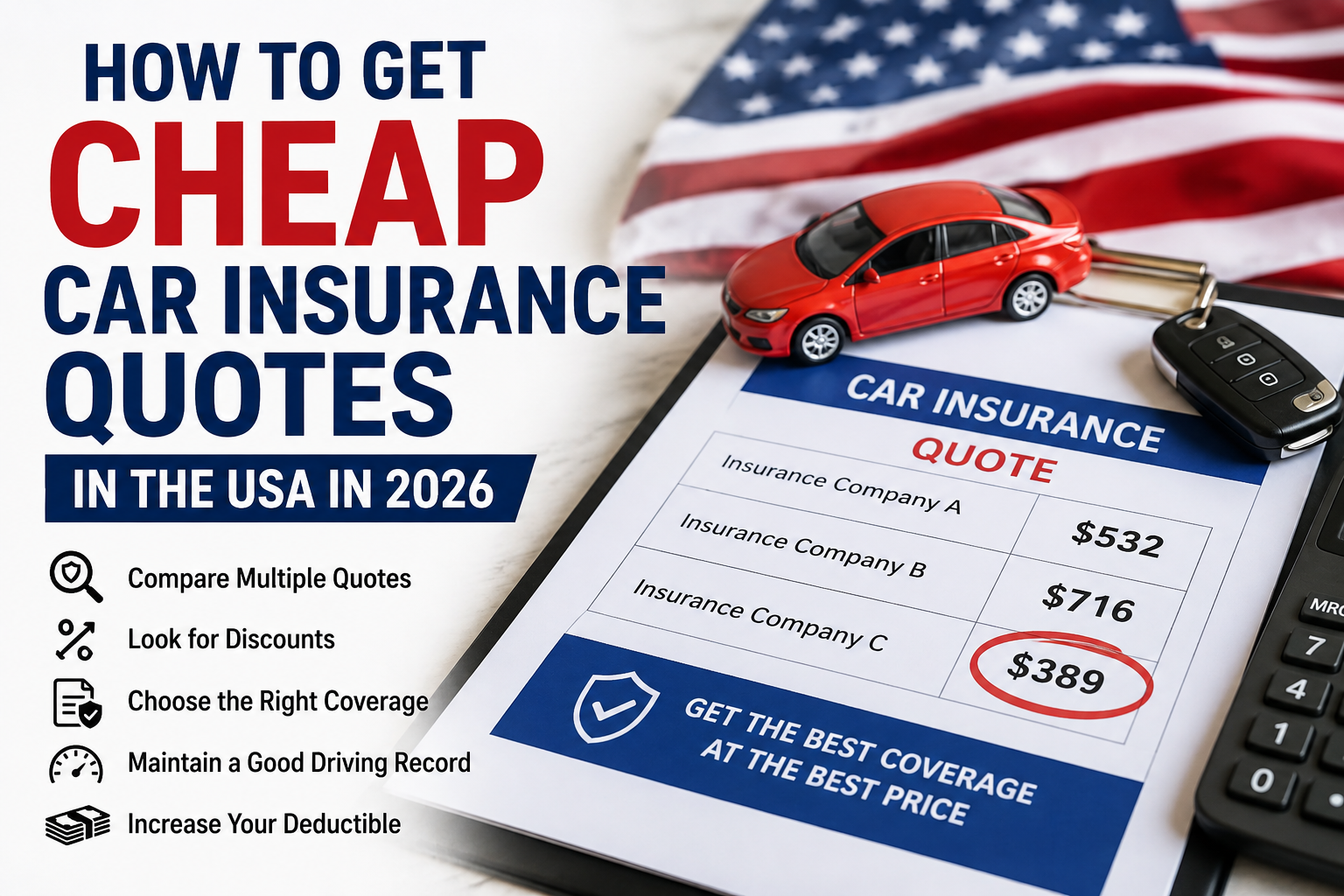
Finding cheap car insurance quotes doesn’t necessarily mean choosing the policy with the lowest advertised price. The goal is to find affordable coverage that still provides enough protection for your vehicle, yourself and other drivers.
Insurance prices can vary significantly between companies because insurers use different factors when calculating premiums. The National Association of Insurance Commissioners (NAIC) recommends comparing quotes using the same coverage and limits so you can make a meaningful price comparison.
What Is a Cheap Car Insurance Quote?
A cheap car insurance quote is an estimate of the premium an insurer may charge for your selected coverage.
Your quote can depend on factors such as:
- Driving record
- Age and driving experience
- ZIP code and location
- Vehicle make and model
- Annual mileage
- Coverage limits
- Deductible
- Previous insurance history
- Claims history
- Available discounts
- Credit-based insurance information where permitted by state law
Because every insurer can evaluate these factors differently, the cheapest company for one driver may not be the cheapest for another.
1. Compare Quotes From Multiple Insurance Companies
One of the most effective ways to find a lower premium is to shop around.
Don’t request just one quote. Compare several insurers and ask each company for the same coverage limits and deductibles.
For example, you might compare:
- GEICO
- Progressive
- State Farm
- Travelers
- Auto-Owners
- Amica
- Erie
- USAA, if eligible
Current 2026 research continues to show substantial differences between insurers for different driver profiles, making comparison especially important.
Important Tip
A quote of $120 per month isn’t necessarily better than one of $135 if the first policy has substantially lower liability limits or higher deductibles.
Always compare coverage, not just price.
2. Ask for Every Available Discount
Discounts can significantly reduce your car insurance premium.
Depending on your insurer and state, you may qualify for discounts for:
- Safe driving
- Multiple vehicles
- Bundling auto and home insurance
- Bundling auto and renters insurance
- Good grades for eligible students
- Defensive-driving courses
- Anti-theft devices
- Vehicle safety equipment
- Low mileage
- Electronic/paperless billing
- Automatic payments
The NAIC specifically recommends asking your insurer which discounts you qualify for because availability varies by company and state.
3. Bundle Your Insurance Policies
If you have homeowners or renters insurance, ask whether combining policies with the same insurer could reduce your total cost.
Bundling can provide a discount, but don’t assume the company with the biggest advertised discount is automatically the cheapest.
Compare the final combined price with competing insurers. Recent 2026 analysis found that some companies offer large bundling discounts while another insurer can still be cheaper because its starting premium is lower.
4. Increase Your Deductible
Your deductible is the amount you generally pay toward a covered claim before your insurer pays the remaining covered amount.
For example, you might compare:
- $500 deductible
- $1,000 deductible
- $1,500 deductible
A higher deductible can lower your premium, but you should only choose a deductible that you could comfortably afford after an accident.
The NAIC also recommends asking how changing deductibles affects your premium.
5. Maintain a Clean Driving Record
Tickets, accidents and other violations can increase insurance costs.
Driving safely over time can help you qualify for better rates and safe-driver discounts where available.
If you’ve recently received a ticket or had an accident, don’t assume every insurer will increase your premium by the same amount. Get new quotes from multiple companies.
6. Consider a Telematics or Usage-Based Program
Some insurers offer programs that use driving data to evaluate driving behavior.
Depending on the program, factors may include:
- Mileage
- Braking
- Acceleration
- Driving times
- Driving patterns
Safe or low-mileage drivers may be able to reduce their premiums, although program rules and potential savings vary.
Before enrolling, read the program’s privacy terms and understand how your driving information will be used.
7. Check Whether You Really Need Every Optional Coverage
Don’t remove important protection simply to make your premium cheaper.
However, if you have an older vehicle, it can be worth reviewing whether optional collision or comprehensive coverage still makes financial sense compared with the vehicle’s current value and the cost of the coverage.
You should also consider whether you need options such as:
- Rental reimbursement
- Roadside assistance
- Gap insurance
- Medical payments coverage
- Custom equipment coverage
Your needs depend on your vehicle, finances and state requirements.
8. Choose the Right Car
The vehicle you drive can have a major effect on your insurance price.
Luxury and sports vehicles can cost more to insure because of factors such as repair costs, theft risk and claims history.
If you’re shopping for a new vehicle, get an insurance quote before purchasing the car.
A vehicle that looks affordable at the dealership could become much more expensive once insurance is included.
9. Drive Fewer Miles If Possible
Mileage can influence insurance premiums because more time on the road can mean greater exposure to accidents.
If you work from home, use public transportation or have a short commute, ask insurers whether you qualify for a low-mileage discount.
Some insurers also offer usage-based programs for drivers who don’t drive frequently.
10. Keep Continuous Insurance Coverage
Avoid allowing your insurance coverage to lapse simply because you’re trying to save money.
A gap in coverage can affect future insurance pricing, depending on the insurer and your circumstances. NAIC shopping guidance notes that maintaining insurance can result in lower rates than having a gap in coverage.
If you’re switching insurers, arrange the new policy before canceling the old one so there isn’t an unnecessary gap.
11. Check Your Insurance Quote Carefully
When requesting quotes, provide accurate information.
Check:
- Vehicle make and model
- VIN
- Address
- Annual mileage
- Driver information
- Driving history
- Coverage limits
- Deductibles
- Previous insurance information
The NAIC advises consumers to provide the same information to each insurer when comparing quotes.
Providing incorrect information just to receive a lower quote can result in a different premium later or create problems with your coverage.
12. Don’t Automatically Stay With the Same Insurance Company
Being a long-term customer doesn’t guarantee that you have the lowest available rate.
Insurance prices can change because of market conditions, claims, driving history, vehicle changes and other factors.
Recent 2026 reporting has highlighted the importance of periodically comparing rates instead of assuming loyalty automatically produces the best price.
A good strategy is to review your policy regularly and obtain competing quotes before renewal.
Cheap Car Insurance Quotes: What to Compare
| Factor | What to Check |
|---|---|
| Monthly premium | Total monthly cost |
| Annual premium | Total yearly cost |
| Liability | Coverage limits |
| Collision | Deductible and coverage |
| Comprehensive | Deductible and covered losses |
| Uninsured motorist | Available protection |
| Discounts | Which discounts apply |
| Deductible | Amount you pay after a covered claim |
| Customer service | Reviews and complaint information |
| Financial strength | Insurer’s ability to pay claims |
The NAIC recommends checking that insurers and agents are licensed in your state and researching complaints before purchasing.
Cheapest Car Insurance Isn’t Always the Best Insurance
It can be tempting to select the lowest number you see.
But a very cheap policy may have:
- Lower liability limits
- Higher deductibles
- Fewer optional coverages
- Less protection for your vehicle
- Limited extras
For this reason, compare price + coverage + deductible + insurer quality rather than price alone.
How to Get Cheap Car Insurance Quotes Online
You can follow this simple process:
Step 1: Collect your driver’s license and vehicle information.
Step 2: Decide what coverage and limits you need.
Step 3: Get quotes from at least 3–5 insurers.
Step 4: Use identical coverage limits and deductibles.
Step 5: Ask each company about discounts.
Step 6: Compare the final annual premium.
Step 7: Check the insurer’s reputation and complaint information.
Step 8: Select the policy that provides the best combination of price and protection.
The NAIC recommends comparing equivalent coverage because otherwise a cheaper quote may simply be offering less protection.
Final Thoughts
The best way to find cheap car insurance quotes in the USA in 2026 is to compare multiple insurers rather than automatically renewing your current policy.
Start by getting several quotes with identical coverage limits and deductibles, then ask about discounts, consider your deductible carefully and review optional coverage that may no longer be necessary.
Most importantly, don’t sacrifice essential protection just to save a few dollars per month. The cheapest policy isn’t always the best value—the right policy is one that provides appropriate coverage at a competitive price.